The guide · written from a real, measured fast
Autophagy and Water Fasting. The Nobel Science, the Timeline Nobody Can Measure and What a Strip Shows
Search for autophagy fasting and you get a chart. Sixteen hours, autophagy begins. Twenty four hours, it ramps up. Seventy two hours, deep cellular cleanup. The chart looks measured. It is not. Nobody has a device that reads autophagy in a living human. Every one of those hour marks is a guess dressed up as data. This guide is written from a fast that measures everything it can and says so about the one thing it cannot. John, 56, is on day 36 of a doctor supervised 90 day water fast. Autophagy is the reason he gives on camera for doing it. Below is what the science actually established, what his morning strip can and cannot show and an honest answer to the question everyone types into the search box.
Three things this page keeps apart
Awarded, measured, claimed. The awarded part is what the 2016 Nobel Prize actually recognized, mechanisms of autophagy worked out in yeast. The measured part is what a urine ketone strip shows every morning on John's fast, the fuel switch from stored carbohydrate to fat. The claimed part is the hour by hour autophagy timeline on every fasting page, which no human study has measured. Most autophagy content blends all three into one confident chart. This page labels each one.
Every strip reading below comes from the live data behind the numbers page. The protocol is water, Celtic salt and electrolytes on a doctor’s schedule and the occasional logged black coffee. His physician has known him for years, watched him complete an 83 day supervised fast before this one, sees monthly bloodwork and can stop the fast on any day.
What autophagy is, from the people who gave it a Nobel Prize
The word is Greek. Auto means self and phagein means to eat. Autophagy is self eating, the process a cell uses to wrap up its own worn out parts, deliver them to a compartment called the lysosome and break them down into raw material it can reuse. Researchers first saw cells doing this in the 1960s. The Belgian scientist Christian de Duve, who discovered the lysosome and won the 1974 Nobel Prize for it, coined the term.
For decades little more was known, because the process was hard to study. In the early 1990s Yoshinori Ohsumi ran a series of experiments in baker’s yeast, identified the genes essential for autophagy, worked out the mechanisms behind it and showed that similar machinery runs in human cells. In 2016 the Nobel Assembly at Karolinska Institutet awarded him the Nobel Prize in Physiology or Medicine for his discoveries of mechanisms for autophagy.
Read that last sentence again, because it matters for every fasting page that quotes it. The prize was for mechanisms. It was awarded for yeast experiments and the cell biology they revealed. It did not test fasting. It did not set a timeline. It did not promise a benefit from skipping meals. Fasting is one of the standard triggers researchers use to turn autophagy up in lab and animal studies, which is real and is why the two ideas travel together. The link between the Nobel Prize and a 72 hour fast is something the internet added afterward.
What John’s strip actually measured, day by day
A urine ketone strip does not read autophagy. It reads ketones, the fuel the liver makes from fat once stored carbohydrate runs out. That is the fuel switch underneath any fasting response. It is the closest measurable thing to the question people are asking. Here is John’s strip from the first morning to this one, with what it can and cannot say at each point.
- DAYS 1 TO 3 · STRIP 0Running on stored carbohydrate
Three blank mornings. The scale moved from 228.6 to 220.6 pounds, mostly water leaving with glycogen. The strip showed nothing. The body was still burning its stored carbohydrate. Whatever autophagy was doing at this stage, nothing on the counter could see it. Day 3 was the wall.
- DAY 4 · STRIP 5First color
The strip showed its first reading on the fourth morning at 218 pounds. This is the switch, the point where the liver is making enough ketones from fat to spill into urine. Day 5 read 8. Days 6 and 7 read 4 and 8. Strips swing with hydration. The trend matters more than any single morning. Day 5 is when John called it.
- DAY 8 · STRIP 16The darkest square
The morning strip hit 16, the deepest reading of the fast, at 211.4 pounds. That is the fat burning machine fully on. It is also where the cranky phase peaked. This is the morning John points to when he says his body is in the state the autophagy research studies. It is a receipt for ketosis. It is not a receipt for autophagy.
- DAYS 8 TO 30 · STRIP 16, 23 MORNINGSHeld at the top of the chart
Twenty three consecutive mornings at 16. The scale went from 211.4 to 190.2 over that stretch. Day 16 is when John first named autophagy as his real reason for the fast and day 27 is when he called it the magic. On both days he held the strip up and said the same thing. This I can show you. The autophagy I take on the research.
- DAY 31 · STRIP 4One small meal reset it
On day 30, after a fainting scare, John had a small homemade broth and some avocado. The next morning the strip had dropped from 16 to 4 and the scale was up to 192. Day 31 has the whole incident. If autophagy timelines were as tidy as the charts say, a bowl of broth would not matter. His strip says the fasting state itself is fragile.
- DAYS 32 TO 35 · STRIP 0Four blank mornings
Zero on the strip four mornings in a row while the scale kept sliding from 192.6 to 190.9. Fat was still burning. The strip could not see it yet. Anyone who tells you the hour a cleanup restarts after a broth is guessing, same as the people who tell you the hour it begins.
- DAY 36 · STRIP 0.5The first trace back
Six days after the broth, the palest square on the chart showed color. John called it barely there and logged it at 0.5. The scale read 190.2, a total of 38.4 pounds below the start. Day 36 is this morning. The fast continues.
The chart, with the numbers that exist
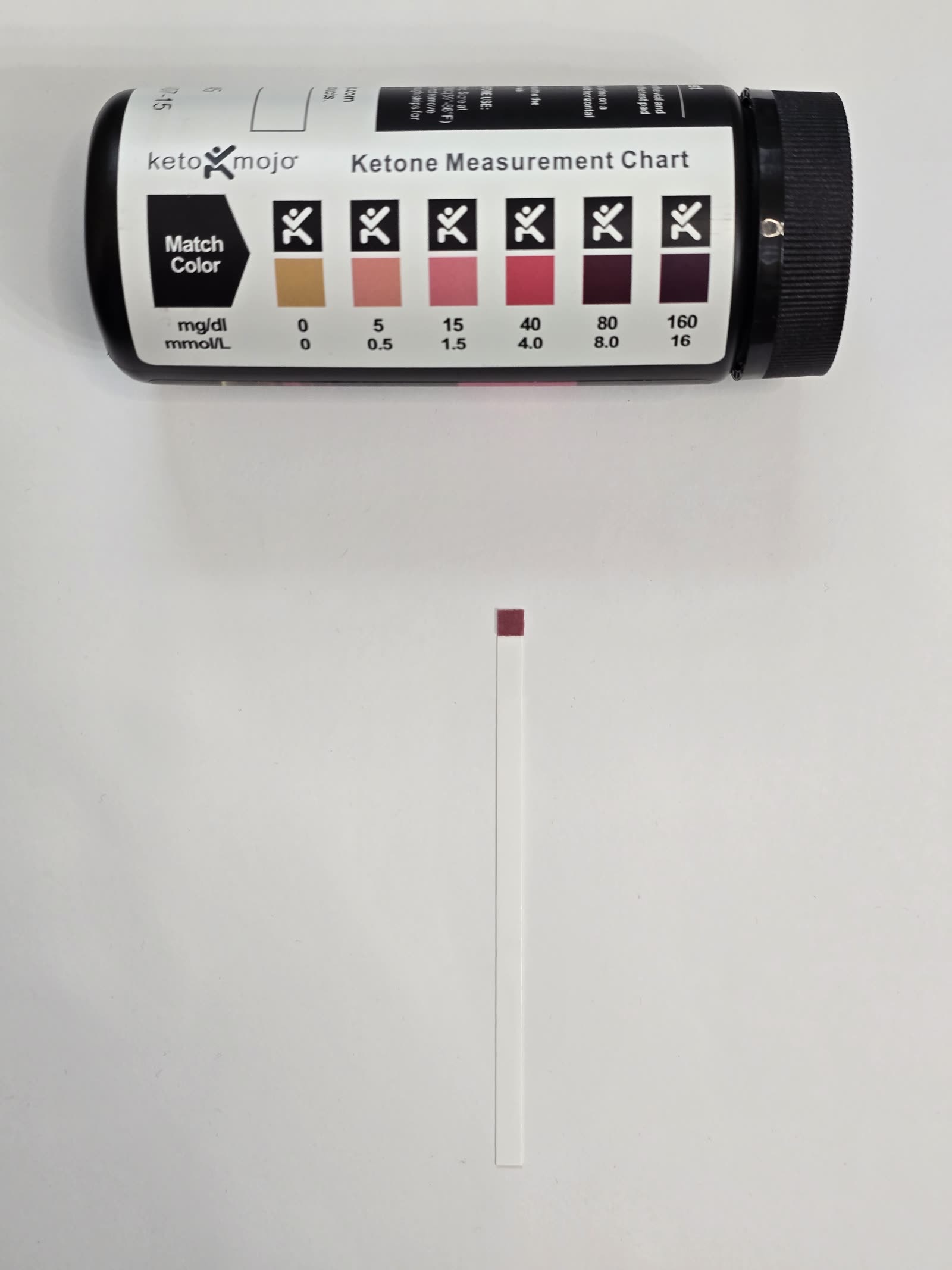
That last tile is the one every autophagy fasting chart leaves off. The strip rows are John’s real mornings. The Nobel row is a matter of record. The missing row, autophagy by the hour, does not exist for him or for anyone. A chart that fills it in is not more informative than this one. It is just more confident.
Why John fasts for autophagy anyway
He is not confused about any of the above. On day 16 he said his liver cells are cleaning themselves out, his skin cells, his kidney cells, even his brain cells. The weight is the visible part and the cleanup is the reason. On day 27 he called autophagy the body’s capability of recycling its cells and giving you a brand new body from within. That is where the magic lies, he said.
Then he holds up a ketone strip, because it is the thing he can hold up. That is the honest version of fasting for autophagy. You do it because the mechanism is real and Nobel documented, because fasting is the trigger researchers use in the lab and because you believe a long enough fast gives your cells the conditions to do more of it. You do not do it because a chart told you the cleanup starts at hour 72. John’s reason is a belief backed by real science. His receipt is ketosis and a scale. He keeps the two separate on camera and this site keeps them separate in print.
What would actually count as evidence
Not his blood panels. His baseline clinic panel and his day 31 home kit measure glucose, kidney markers, lipids and inflammation. Neither has an autophagy line because no commercial panel does. Not the published human trials either. The narrative review of prolonged water fasting in people reports weight, blood pressure, blood markers and safety in supervised fasts that top out around 40 days. It does not report autophagy, because the studies could not measure it.
What would count is a validated marker in a living human, measured before and during a fast, in the tissues people care about. That does not exist yet outside research settings and even there it is contested. Until it does, autophagy fasting is a bet on biology, not a number on a page. This site will publish the number the day it can be measured. It will not print one before then.
Who should never attempt this
Anyone with a medical condition. Anyone on daily medication. Anyone pregnant or breastfeeding. Anyone under 18. Anyone with a history of an eating disorder. Anyone without a doctor who knows them and will watch the blood. Fasting for autophagy adds a specific risk on top of the usual ones, which is the temptation to push a fast longer than is safe because a chart promised something at hour 72 or day 5. The published human trials of prolonged water fasting all run under medical supervision. John’s fast is one supervised man’s record and a reason, not a template.
Day 36, still running
The strip that produced every reading above gets dipped again tomorrow morning. The day 36 note has today’s scale and the faint trace on the strip. The benefits guide sorts everything else he has measured into what the numbers show, what he reports and what this fast cannot prove. Autophagy sits in the last pile, on purpose, with the man who is fasting for it saying so.
Quick answers
What is autophagy, in plain words?
The word comes from two Greek roots. Auto means self and phagein means to eat. Autophagy is the housekeeping process cells use to break down their own worn out parts, old proteins and damaged mitochondria. It then recycles them into fuel and building blocks. It runs at a low level in every cell all the time. Researchers first saw cells destroying their own contents in the 1960s. Yoshinori Ohsumi used baker's yeast in the early 1990s to find the genes that make it work and won the 2016 Nobel Prize in Physiology or Medicine for it.
Does water fasting trigger autophagy?
In lab and animal studies, yes. Fasting and calorie restriction are the standard tools researchers use to turn autophagy up, because when nutrients stop arriving, cells start breaking down their own components for energy and raw material. The human side is far less settled. How strong the effect is, in which tissues and on what schedule is not something anyone has measured in a fasting person. John's fast cannot measure it either. What his strip shows is that the fuel switch behind it is flipped, with ketones at the darkest square from day 8 to day 30.
When does autophagy start when you fast?
Nobody can give you an honest hour. Autophagy cannot be measured directly in a living human the way glucose or ketones can. The exact figures you see online, 16 hours, 24 hours, 72 hours, are extrapolations from animal work and not human timelines. It is also never fully off. Your cells do this housekeeping every day at some level. The one thing John can point to is when his body finished switching fuels. His strip was blank on days 1 to 3, showed 5 on day 4 and 8 on day 5 and read 16 on day 8. Autophagy he takes on the research, not on a gadget.
How long should you fast for autophagy?
There is no measured human answer and this page will not invent one. What the research does say is that supervised prolonged water fasts in the published human trials top out around 40 days and every one of them ran under medical supervision. John is past day 36 of a 90 day fast because he wants the cell level benefit and believes a longer fast gives it more time. That is his bet, made with a doctor who has known him for years, monthly bloodwork and stop authority sitting with his physician. It is not a dose anyone can prescribe.
Can you measure autophagy with a ketone strip?
No. A urine ketone strip measures ketones, the fuel the liver makes from fat once stored carbohydrate runs out. It tells you the body has switched fuels. It says nothing about how much cell recycling is happening. The two are linked in the sense that both are responses to food stopping, which is why John shows his strip when he talks about autophagy. His day 8 strip read 16 and it stayed there for 23 mornings. That is a receipt for ketosis. There is no receipt for autophagy and anyone selling one is ahead of the evidence.
What did the 2016 Nobel Prize actually reward?
The Nobel Assembly at Karolinska Institutet awarded the 2016 Nobel Prize in Physiology or Medicine to Yoshinori Ohsumi for his discoveries of mechanisms for autophagy. In a series of experiments in the early 1990s he used baker's yeast to identify the genes essential for autophagy and then worked out the underlying mechanisms and showed similar machinery runs in human cells. The prize recognized the biology. It did not test fasting, did not set a timeline and did not promise any benefit from skipping meals. Fasting pages that lean on the prize are borrowing its credibility for claims it never made.
Does a 3 day water fast give you autophagy?
It gets you all the way through the fuel switch, which is the measurable part. John's strip was blank on days 1 to 3 and showed its first color on day 4. Three days is roughly where his body finished moving from stored carbohydrate to fat. Whether that means a meaningful amount of autophagy happened in his cells is not something anyone can measure. If you are fasting three days for autophagy, be honest with yourself that the reason is a belief in the research and the receipt you get is ketosis, not a cleanup count. The 3 day guide covers the first 72 hours morning by morning.